
Document E, and its implementation by ENS helps ensure that homes, hotels, student halls, and other buildings provide a decent level of acoustic privacy.
-
 Value-Focused Insight
-
 Fast & Trustworthy Support
-
 Practical, Proven Solutions
What is Approved Document E?
Approved Document E is one of the statutory guidance documents that support the Building Regulations 2010 in England and Wales. Its full title is “Resistance to the Passage of Sound”, and it provides practical guidance on how to meet the legal requirements for sound insulation in buildings, both new build and conversions.
The aim of Document E is to ensure that buildings are designed and constructed so that they provide reasonable resistance to airborne and impact sound, helping to protect the occupants’ health and wellbeing from noise disturbance.




Approved Document E sets minimum standards for sound insulation, expressed as DnT,w + Ctr for airborne sound and L’nT,w for impact sound. These values describe how much sound is reduced by as it travels through walls, floors, or ceilings.
For example:
For new purpose-built dwellings:
- Airborne sound insulation (walls and floors): Minimum 45 dB DnT,w + Ctr
- Impact sound insulation (floors): Maximum 62 dB L’nT,w
For converted buildings (material change of use):
Slightly lower standards are allowed because conversions can be technically more challenging:
- 43 dB DnT,w + Ctr for airborne
- 64 dB L’nT,w for impact
Rooms for residential purposes (like hotels and care homes) have similar targets but combine the new build and conversions standard as there are often flanking sound limitations with walls and the layout of rooms (doors are often ‘back-to-back’ on the corridor).
What does Approved Document E cover?
Approved Document E applies to:
- Dwelling-houses and flats (new build and conversions)
- Rooms for residential purposes (e.g., hotels, student accommodation, care homes, hostels)
- Schools (only Part E4)
- Common parts of buildings that adjoin dwellings (e.g., corridors)
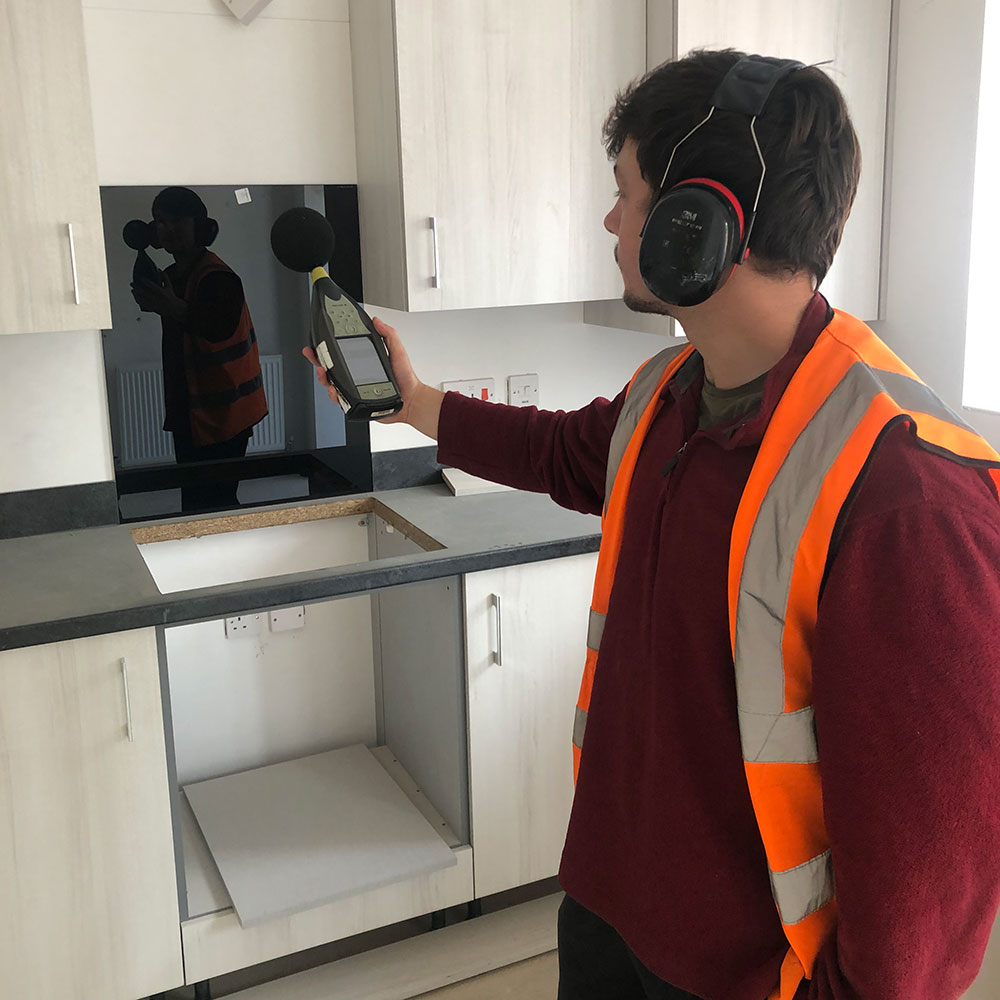
Pre-completion Testing
One of the key requirements under Document E is that most new dwellings and conversions must undergo pre-completion sound insulation testing before they can be signed off by Building Control.
A suitably qualified person, usually a registered Association of Noise Consultants (ANC) acoustic consultant such as ENS, carries out these tests to check that the construction actually achieves the performance standards. Tests involve:
- Airborne tests: Using loudspeakers to generate noise and measuring the difference in sound levels between rooms.
- Impact tests: Using a tapping machine to simulate footsteps and measuring how much sound passes through the floor.


Part E4: Schools
Part E4 is a special section that requires schools to have acoustic conditions that support teaching and learning. While Document E sets out the basic requirement, it refers to Building Bulletin 93 (BB93) for the detailed design standards. This includes limits on:
- Internal ambient noise levels
- Reverberation times
- Sound insulation between rooms
For example, classrooms must have low background noise to ensure speech is intelligible. Note that, Special Educational Needs and Disability (SEND) Schools have more stringent acoustic requirements to meet the needs the pupil.
Robust Details
Introduced in 2004 alongside Document E, the Robust Details scheme is an alternative to pre-completion testing. Builders can use tried-and-tested constructions listed in the Robust Details Handbook, which, if installed correctly, are known to meet or exceed Document E standards.
This helps housebuilders avoid the risk of failing tests, but requires careful workmanship and auditing. You must also check that your selected walls and floor details are compatible – call us if you are unsure – as some combinations fail to comply with the requirements of Part E!
Design Considerations
Meeting Document E standards is not just about adding more insulation. Good acoustic design includes:
- Double-leaf walls with cavities.
- Staggered or isolated studs.
- Single acoustic studs to maximise floor space.
- Resilient bars and floating floors.
- Sealing gaps around pipes and services.
- Avoiding flanking transmission (sound bypassing the main barrier through junctions).
Poor workmanship, like gaps in plasterboard or badly fitted sockets, can easily cause test failures.
Why is Approved Document E Important?
Approved Document E has improved living standards by addressing one of the most common sources of complaints in housing: unwanted noise from neighbours. Before its introduction, many conversions of large houses into flats suffered from poor sound insulation, leading to disputes and stress for residents.
By setting clear standards, requiring testing, and encouraging robust design, Document E, and its implementation by ENS helps ensure that homes, hotels, student halls, and other buildings provide a decent level of acoustic privacy.